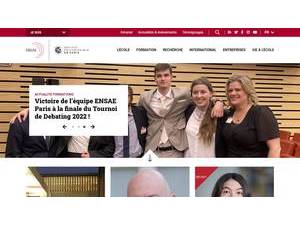
ENSAE Paris (National School of Statistics and Economic Administration) is a non-profit public higher education institution located in the urban setting of the large town of Palaiseau, Ile-de-France, France. Established in 1942, ENSAE Paris (ENSAE) is a coeducational institution and is officially recognized by the Ministère de l'Enseignement supérieur et de la Recherche. ENSAE provides programs and courses leading to officially recognized higher education degrees, such as master's degrees in several areas of study. Further information can be found in the uniRank degree levels and areas of study table below or by searching the institution's website through the search engine below. This 84-year-old French higher education institution has a selective admission policy based on entrance examinations. Its acceptance rate is 0-9%. This makes it an extremely selective. International applicants are eligible to apply. ENSAE also provides several academic and non-academic facilities and services, including a library, housing, sports facilities, financial aid and/or scholarships, study abroad and exchange programs, and administrative services.
Control
public
Entity
non-profit
Size
very small-sized
Selectivity
extremely selective
| Name | ENSAE Paris |
|---|---|
| Name (English) | National School of Statistics and Economic Administration |
| Name (Non Latin) | n.a. |
| Acronym | ENSAE |
| Founded | 1942 |
| Motto | La grande école de l'économie, de la statistique, de la finance et de l'assurance |
| Colours | |
| Mascot |
Do you work for this university?
CLAIM / UPDATE UNIVERSITY| Address | 5 Av. Le Chatelier Palaiseau 91120 Ile-de-France France |
|---|---|
| Location Map
Satellite View Street View |
|
| (0)1 41 17 65 25 | |
| (0)1 41 17 48 52 | |
| Other locations |
ENSAE Paris is legally chartered, licensed and/or institutionally accredited by: Ministère de l'Enseignement supérieur et de la Recherche
Year of first Recognition or Accreditation
Not available; please use the Feedback/Error report form at the end of this page to submit a list of ENSAE Paris's official programmatic or specialized accreditations. If you are an official representative of ENSAE Paris you can also claim and update your entire university profile free of charge.
Tip: search for ENSAE Paris's accreditations with the uniRank Search Engine
There are different types of legal recognition and quality assessment of higher education institutions around the world, depending on the country and its legal and higher education system... read our article about university accreditation and recognition to learn more.
The following Fields of Study/Degree Levels Matrix of ENSAE Paris is divided into 6 main fields of study and 4 levels of degrees, from the lowest undergraduate degree to the highest postgraduate degree. This matrix aims to help quickly identify ENSAE Paris's academic range and degree level offering.
| Undergraduate | Postgraduate | |||
|---|---|---|---|---|
|
PreBach degrees |
Bachelor degrees |
Master degrees |
Doctoral degrees |
|
| Yes | ||||
| A&H | Yes | |||
| L&C | ||||
| B&S | ||||
| M&H | ||||
| S&T | Yes | |||
| Eng | ||||
What is the difference between comprehensive/generalist and specialized universities in terms of the range of fields of study they offer, degree levels available and academic and carreer paths pros and cons? Read our guide article about generalist and specialized universities to learn more.
Click here to explore a list of ENSAE Paris courses and programs, or if they are not available yet, search for them with our search engine powered by Google. We are constantly adding university courses and programs worldwide with the cooperation of university representatives.
You can also explore our Guide to University Programs and Courses to learn more about study outlines and typical duration, tuition ranges, career prospects and salary expectations for careers associated with more than 8,100 programs and courses.
This Tuition Fees Range Matrix of ENSAE Paris categorizes tuition fees by student type (local or international) and degree level (undergraduate or postgraduate). It aims to help students get an approximate idea of the estimated yearly tuition fees at ENSAE Paris.
| Undergraduate | Postgraduate | |
|---|---|---|
| Local students |
0-999 US$ (0-910 Euro) | 0-999 US$ (0-910 Euro) |
| International students |
0-999 US$ (0-910 Euro) | 12,500-14,999 US$ (11,390-13,670 Euro) |
Tip: search for ENSAE Paris's tuition fees with the uniRank Search Engine
Yearly tuition fees refers to the amount of money that a student is charged by a University for one academic year of full-time study. Read our guide article about tuition fees and financial aid options to learn more.
ENSAE Paris is a coeducational institution, admitting both men and women to its programs and degrees.
ENSAE Paris has a selective admission policy based on entrance examinations for prospective students.
ENSAE Paris's acceptance rate ranges from 0 to 9%, making it an extremely selective higher education institution.
This institution does not have a special focus on promoting education or research among a specific minority or ethnic group.
Not reported
Yes
Tip: search for ENSAE Paris's admission policy with the uniRank Search Engine
Applying for admission is the first step towards achieving students' academic and career goals and accessing the many opportunities and resources that a university has to offer. Read our Introduction to University Admissions article to learn more.
ENSAE Paris has a student enrollment ranging from 250 to 499, making it a very small-sized institution.
ENSAE Paris's academic staff ranges from 50 to 99 members.
ENSAE Paris is a public higher education institution, meaning it is funded and managed by the government, providing affordable access to education for students.
ENSAE Paris is a non-profit higher education institution, relying on government subsidies and reinvesting all revenue into programs, research and student services rather than distributing profits to owners or shareholders.
ENSAE Paris's main campus is located in an urban setting, meaning it is situated within a city.
ENSAE Paris adopts a semesters academic calendar, a scheduling system where the academic year is divided into two main terms, or semesters, each typically lasting about 15 to 18 weeks, separated by a long break, usually a winter or summer vacation.
Not reported
None.
University size and profile can be important factors to consider when choosing a university. Here are some potential reasons why University size and profile can affect students when choosing a university.
Yes
Not reported
Yes
Yes
Not reported
Not reported
Not reported
What are the most common University facilities and services? Read our two guide articles about University Facilities and University Services to learn more.
Not available; please use the Feedback/Error report form to submit a list of ENSAE Paris's official first-level academic divisions.
Read our guide article "Understanding Academic Divisions in Universities - Colleges, Faculties, Schools" to learn more about academic divisions and typical university organizational structures.
uniRank publishes the following list of the most important ENSAE Paris's affiliations and memberships; feel free to submit any relevant missing higher education-related organizations this university is affiliated with.
University memberships and affiliations to external organizations can be important for several reasons... read our article about university affiliations and memberships to learn more.
This higher education institution is not a member of the Open Education Global (OEGlobal) organization that is developing, implementing, and supporting free open education and free online courses. View a list of Open Education Global members by country.
Unlock your University's potential: spotlight your Institution on UniRank for leads, local recognition and branding. Enquiry now to feature your University here.
Social Media
Official Social Media Channels
ENSAE Paris's Facebook page review
ENSAE Paris's X page review
ENSAE Paris's Youtube page review
ENSAE Paris's Instagram page review
ENSAE Paris's official LinkedIn profile
n.a.
Related Guide Articles
Social media can be a powerful tool for Universities to communicate with current students, alumni, faculty, staff and the wider community. But how can social media be important for prospective students? Read our article about the importance of Social Media for universities and prospective students to learn more.