Study in Australia
Universities and Higher Education in Latin America

Universities in Latin America

Higher Education in Latin America

Introduction

What are the most popular Universities in each Latin American country? uniRank answers this question by publishing a list of Latin American countries and providing a ranking of their higher-education institutions meeting the following uniRank selection standards:

  • Accreditation: the institution must be chartered, licensed or accredited by the appropriate higher education-related organization in its country
  • Degree Offerings: it must offer at least three-year bachelor’s degrees, or postgraduate master’s or doctoral degrees
  • Mode of Delivery: it must deliver courses predominantly in a traditional, non-distance education format

UniRank also publishes below a search engine powered by Google that searches all Universities in Latin America and a statistical snapshot of higher education in Latin America and its current challenges.

Latin American Universities by Country

Latin American Universities Search Engine

search 1,840+ universities in Latin America for programs, courses, degrees, scholarships etc.

Universities in Latin America: Key Statistics 2026

Universities and higher education institutions in Latin America in 2026

How Many Universities Are There in Latin America in 2026?

According to the uniRank database, there are currently 1,841 officially recognized higher education institutions in Latin America in 2026. These institutions are included in the uniRank directory of officially recognized universities and higher education institutions worldwide.

The uniRank database currently includes 14,040 officially recognized higher education institutions worldwide. Latin American higher education institutions therefore account for:

  • 13.11% (uniRank Latin American Universities World Representation Index) of all officially recognized higher education institutions included in the uniRank database.

Latin America accounts for approximately 8.6% of the world's population, according to United Nations population estimates. Compared with its share of the global population, Latin America's share of officially recognized higher education institutions is therefore higher. This provides one indicator of the relative size of the region's higher education sector within the global higher education landscape.


How Many Public and Private Universities Are There in Latin America?

Of the 1,841 officially recognized higher education institutions in Latin America included in the uniRank database in 2026, 848 (46.1%) are public institutions and 993 (53.9%) are private institutions.

  • Public higher education institutions: 848 (46.1%)
  • Private higher education institutions: 993 (53.9%)
  • Total: 1,841

The figures show a relatively balanced distribution between public and private higher education institutions across Latin America, although private institutions account for a slightly larger share overall. The balance varies considerably between individual Latin American countries and their respective higher education systems.

Public institutions are more strongly represented among the region's highest-ranked universities. In the uniRank Top 200 Universities in Latin America, 127 institutions (63.5%) are public higher education institutions.


How Many Non-Profit and For-Profit Universities Are There in Latin America?

Of the 1,841 officially recognized higher education institutions in Latin America included in the uniRank database in 2026, 1,669 (90.7%) are non-profit institutions and 172 (9.3%) are for-profit institutions.

  • Non-profit higher education institutions: 1,669 (90.7%)
  • For-profit higher education institutions: 172 (9.3%)
  • Total: 1,841

Non-profit institutions therefore represent the large majority of higher education institutions in Latin America. The legal and organisational classification of individual institutions can vary between countries, reflecting differences in national higher education legislation and institutional structures.

Public universities and other public higher education institutions in Latin America are generally not-for-profit in their institutional purpose, although their precise legal status and organisational structure vary between national higher education systems.


Higher Education in Latin America: 2026 Snapshot

The infographic below summarises key statistics about universities and higher education in Latin America in 2026, including the number of officially recognized institutions and their distribution by public or private and non-profit or for-profit status.
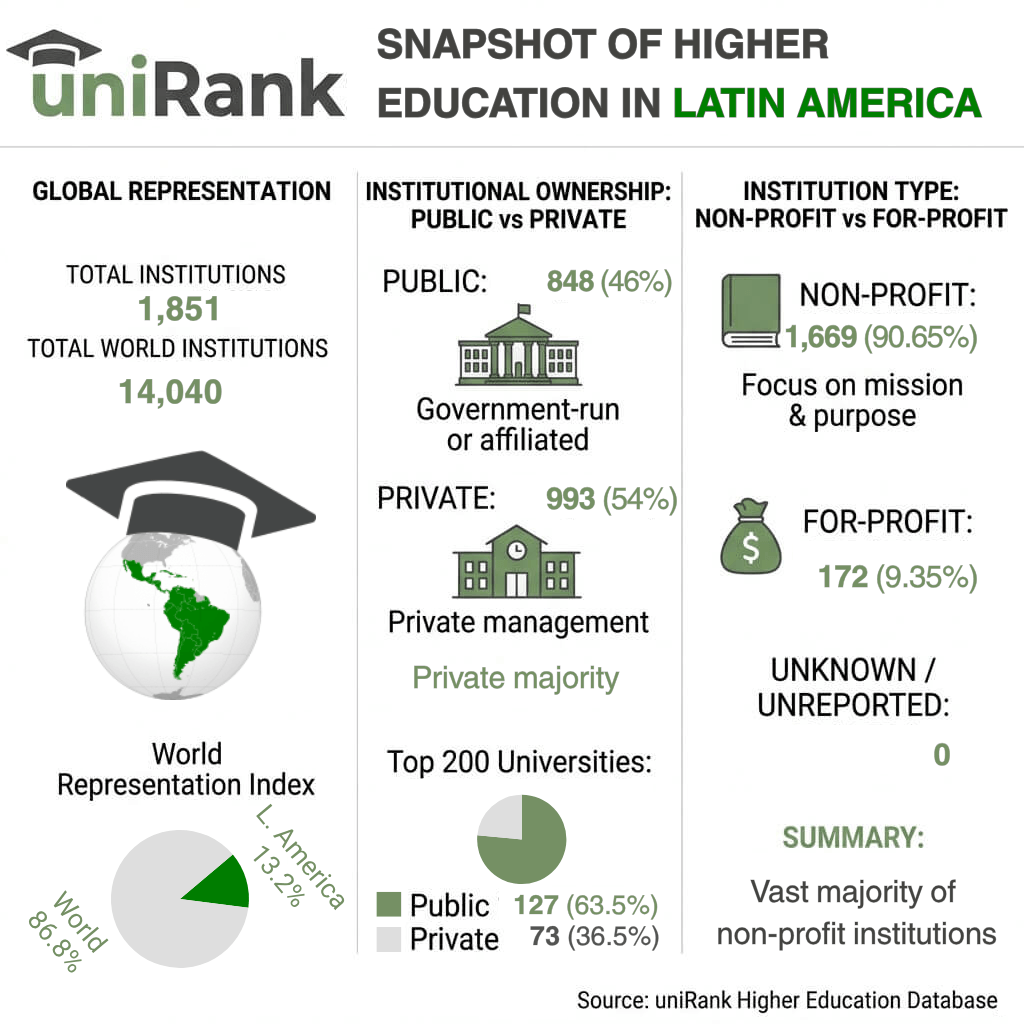
Higher education in Latin America 2026: statistics on universities, public and private institutions, and non-profit and for-profit higher education institutions

Challenges for the higher education systems in Latin America

Latin America is a region rich in cultural diversity, economic potential and demographic growth. Over the past decades, higher education has expanded significantly, with rising enrolment rates and increasing demand for skilled professionals. However, structural inequalities, economic volatility and uneven institutional development continue to affect the performance and stability of the region’s higher education systems.

According to uniRank, universities across Latin America face a series of persistent and interconnected challenges that influence access, quality, research output and workforce alignment. This expanded report outlines the principal issues shaping the future of higher education in Latin America.


A) Access, Affordability and Persistent Inequality

Despite progress in overall enrolment, access to higher education remains highly unequal across socioeconomic groups. Students from disadvantaged backgrounds face multiple barriers, including:

  • high tuition fees in private institutions
  • limited public university capacity
  • poor-quality secondary education preparation
  • geographic barriers, particularly in rural or remote areas
  • lack of academic and financial support once enrolled

Social inequality deeply shapes the region’s education outcomes. Even when students from low-income families enter university, they often face discrimination, limited resources and challenges in completing their programs. These barriers reduce social mobility and limit the region’s ability to build a skilled workforce.

B) Chronic Underfunding

Many universities in Latin America face persistent funding shortages that restrict their ability to modernize and expand. Economic instability and competing government priorities frequently result in:

  • aging infrastructure and overcrowded campuses
  • low investment in libraries, laboratories and digital technology
  • limited research funding
  • difficulty attracting and retaining qualified faculty
  • insufficient student support services

These financial constraints directly affect educational quality and international competitiveness.

C) Low Research and Innovation Output

Although some Latin American universities produce high-quality research, overall research output in the region remains relatively low. Common challenges include:

  • limited research funding and grants
  • insufficient laboratory infrastructure
  • lack of stable research careers
  • weak collaboration between universities and industry
  • administrative hurdles and limited access to international networks

This research gap reduces the region’s ability to innovate, contribute to global scientific advancements and support local development.

D) Slow Digital Transformation

Technology is rapidly transforming higher education worldwide, but digital readiness varies widely across Latin America. Many universities face challenges such as:

  • unreliable or limited internet connectivity
  • insufficient digital tools for teaching and learning
  • low faculty training in online pedagogies
  • slow adoption of virtual learning platforms

These issues became especially visible during the COVID-19 pandemic, when many institutions struggled to transition to online learning. Improving digital infrastructure is essential for ensuring relevance and resilience.

E) Employability and Skills Mismatch

Latin American economies are changing quickly, yet university programs often fail to adapt at the same pace. This results in a persistent skills mismatch where graduates lack the competencies employers need, such as:

  • digital and technical skills
  • critical thinking and problem-solving
  • communication and teamwork
  • entrepreneurial skills and practical experience

Strengthening curriculum relevance and building stronger partnerships with industry are crucial for improving graduate employability.

F) Brain Drain and Talent Migration

Many of the region’s brightest students and most accomplished researchers leave Latin America in search of better opportunities, higher salaries and more stable research environments abroad. This ongoing brain drain leads to:

  • a loss of academic talent
  • reduced research output
  • weakened innovation ecosystems
  • slower economic and scientific development

Creating competitive academic careers and improving research funding are essential to retain talent.

G) Lack of Harmonization Across Higher Education Systems

Unlike regions with coordinated frameworks—such as Europe’s Bologna Process—Latin America lacks continent-wide harmonization. Differences in accreditation, degree structures and quality assurance systems complicate student mobility and regional integration. Existing efforts such as MERCOSUR education initiatives help, but remain limited in scope.

H) Political Instability and Policy Discontinuity

Frequent political changes and episodes of social unrest affect higher education policy and funding. Shifts in government priorities often lead to:

  • inconsistent long-term planning
  • rapid changes to regulations and financing models
  • interruptions in research programs
  • uncertainty for universities, faculty and students

Stable and predictable education policies are necessary to support sustainable institutional development.

Conclusion

Addressing these challenges requires stronger coordination among governments, higher education institutions, employers, private industry and international partners. Potential solutions include expanding financial aid programs, investing in digital transformation, increasing funding for research and innovation and aligning curricula more closely with the needs of the labour market.

By promoting collaboration, stability and long-term investment, Latin America can strengthen its higher education systems and enhance its capacity for economic growth, innovation and social development.


Top 200 Universities in Latin America

uniRank publishes twice a year a non-academic university ranking of the top 200 Universities in Latin America based on valid, unbiased and non-influenceable web metrics provided by independent web intelligence sources. Please read the ranking methodology on the About Us page for more information.