Study in Australia
Universities and Higher Education in Europe

Universities in Europe

Higher Education in Europe

Introduction

What are the most popular Universities in each European country? uniRank answers this question by publishing a list of European countries and providing a ranking of their higher-education institutions meeting the following uniRank selection criteria:

  • Accreditation: the institution must be chartered, licensed or accredited by the appropriate higher education-related organization in its country.
  • Degree Offerings: it must offer at least three-year bachelor’s degrees, or postgraduate master’s or doctoral degrees.
  • Mode of Delivery: it must deliver courses predominantly in a traditional, non-distance education format.

UniRank also publishes below a search engine powered by Google that searches all Universities in Europe and a statistical snapshot of higher education in Europe and its current challenges.

European Universities by Country

European Universities Search Engine

search 2,000+ universities in Europe for programs, courses, degrees, scholarships etc.

Universities in Europe: Key Statistics 2026

Universities and higher education institutions in Europe in 2026

How Many Universities Are There in Europe in 2026?

According to the uniRank database, there are currently 2,654 officially recognized higher education institutions in Europe in 2026. These institutions are included in the uniRank directory of officially recognized universities and higher education institutions worldwide.

The uniRank database currently includes 14,040 officially recognized higher education institutions worldwide. European higher education institutions therefore account for:

  • 18.90% (uniRank European Universities World Representation Index) of all officially recognized higher education institutions included in the uniRank database.

Europe accounts for approximately 10% of the world's population, according to United Nations population estimates. Compared with its share of the global population, Europe's share of officially recognized higher education institutions is therefore higher. This provides one indicator of the relative size of Europe's higher education sector within the global higher education landscape.


How Many Public and Private Universities Are There in Europe?

Of the 2,654 officially recognized higher education institutions in Europe included in the uniRank database in 2026, 1,913 (72.1%) are public institutions and 741 (27.9%) are private institutions.

  • Public higher education institutions: 1,913 (72.1%)
  • Private higher education institutions: 741 (27.9%)
  • Total: 2,654

The figures show that public higher education institutions account for a substantially larger share of Europe's higher education sector than private institutions. However, the balance between public and private universities varies considerably between individual European countries and their respective higher education systems.

Public institutions are particularly strongly represented among Europe's highest-ranked universities. In the uniRank Top 200 Universities in Europe, 193 institutions (96.5%) are public higher education institutions.


How Many Non-Profit and For-Profit Universities Are There in Europe?

Of the 2,654 officially recognized higher education institutions in Europe included in the uniRank database in 2026, 2,408 (90.7%) are non-profit institutions and 246 (9.3%) are for-profit institutions.

  • Non-profit higher education institutions: 2,408 (90.7%)
  • For-profit higher education institutions: 246 (9.3%)
  • Total: 2,654

Non-profit institutions therefore represent the large majority of higher education institutions in Europe. The legal and organisational classification of individual institutions can vary between countries, reflecting differences in national higher education legislation and institutional structures.

Public universities and other public higher education institutions in Europe are generally not-for-profit in their institutional purpose, although their precise legal status and organisational structure vary between national higher education systems.


Higher Education in Europe: 2026 Snapshot

The infographic below summarises key statistics about universities and higher education in Europe in 2026, including the number of officially recognized institutions and their distribution by public or private and non-profit or for-profit status.
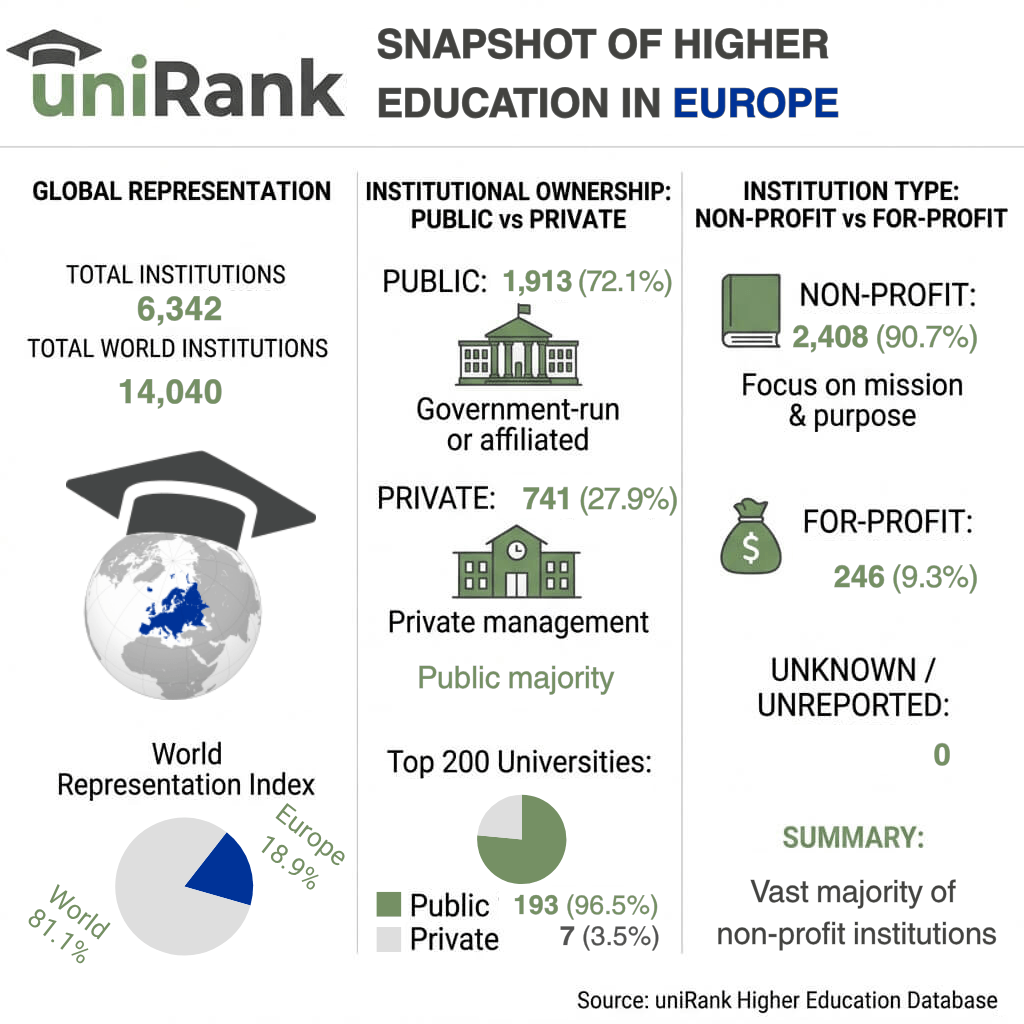
Higher education in Europe 2026: statistics on universities, public and private institutions, and non-profit and for-profit higher education institutions

Challenges for the higher education systems in Europe

Europe has long been home to some of the world’s most prestigious universities, influential research institutions and well-established education traditions. However, the continent’s higher education systems are undergoing significant transition as they respond to demographic, economic and global pressures.

According to uniRank, European higher education institutions face a number of systemic challenges that directly affect their capacity to innovate, compete globally and prepare graduates for a rapidly evolving job market. This report outlines the key challenges shaping higher education in Europe today.


A) Funding Constraints and Financial Pressures

Many European countries have faced prolonged periods of economic strain, leading to budget cuts or stagnation in public funding for universities and research institutions. While some nations have maintained strong investment, others struggle with:

  • restricted research budgets
  • aging infrastructure
  • difficulty hiring and retaining world-class faculty
  • increasing reliance on student tuition fees
  • limited support for innovation and technology upgrades

These financial constraints make it challenging for universities to maintain high academic standards and compete with global peers.

B) Growing Global Competition

The rise of Asia—particularly China, Singapore, South Korea and Japan—as global higher education powerhouses has significantly intensified international competition.

This shift has created new challenges for Europe, including:

  • a growing brain drain as top researchers are attracted by Asian funding and infrastructure
  • strong competition for international students
  • declining global rankings for some European institutions
  • increased pressure to internationalize and modernize

As universities worldwide expand their research capabilities and global visibility, Europe must adapt to remain competitive.

C) Demographic Decline and Population Aging

Europe is experiencing one of the most pronounced demographic shifts in the world. Low birth rates, an aging population and shrinking youth cohorts mean that fewer students will enter higher education in the coming decades.

This demographic decline poses serious challenges:

  • lower student enrolment in many countries, especially in Eastern and Southern Europe
  • reduced funding in systems where budgets depend on enrolment numbers
  • potential closure or consolidation of smaller institutions
  • increasing competition among universities for a shrinking pool of domestic students

Reversing these demographic trends requires long-term policy solutions and supportive social policies.

D) Employability and Curriculum Relevance

European labour markets are evolving rapidly due to technological change, automation and new industry structures. Employers increasingly expect graduates to possess both strong discipline-specific knowledge and transferable skills such as:

  • digital literacy
  • problem-solving and analytical abilities
  • creativity and innovation
  • communication and teamwork
  • entrepreneurial thinking

To remain relevant, universities must strengthen ties with industry, update curricula regularly and expand opportunities for internships, apprenticeships and work-integrated learning.

Conclusion

Addressing these challenges requires coordinated efforts among European policymakers, higher education institutions, employers and regional organizations. Sustained investment in higher education and research is essential to safeguard Europe’s global competitiveness.

In addition, long-term demographic renewal will require stronger social and family policies such as:

  • paid parental leave
  • affordable childcare
  • housing support for young families
  • tax incentives for parents

These measures can help ease the financial burden of raising children and encourage population growth, ensuring a stable future supply of students and highly skilled workers.

With strategic collaboration and sustained reform, Europe’s higher education systems can continue to play a pivotal role in innovation, economic development and cultural leadership on the global stage.


Top 200 Universities in Europe

uniRank publishes twice a year a non-academic university ranking of the top 200 Universities in Europe based on valid, unbiased and non-influenceable web metrics provided by independent web intelligence sources. Please read the ranking methodology on the About Us page for more information.