Universities and Higher Education in Asia

Universities in Asia

Higher Education in Asia

Introduction

What are the most popular Universities in each Asian country? UniRank endeavors to address this query by publishing a list of Asian countries and providing a ranking of their higher-education institutions meeting the following uniRank selection criteria:

  • Accreditation: the institution must be chartered, licensed or accredited by the appropriate higher education-related organization in its country.
  • Degree Offerings: it must offer at least three-year bachelor’s degrees, or postgraduate master’s or doctoral degrees.
  • Mode of Delivery: it must deliver courses predominantly in a traditional, non-distance education format.

UniRank also publishes below a search engine powered by Google that searches all Universities in Asia and a statistical snapshot of higher education in Asia and its current challenges.

Asian Universities by Country

Asian Universities Search Engine

search 2,000 universities in Asia

Snapshot of Higher Education in Asia

Higher Education and Universities in Asia

Asian Universities World Representation

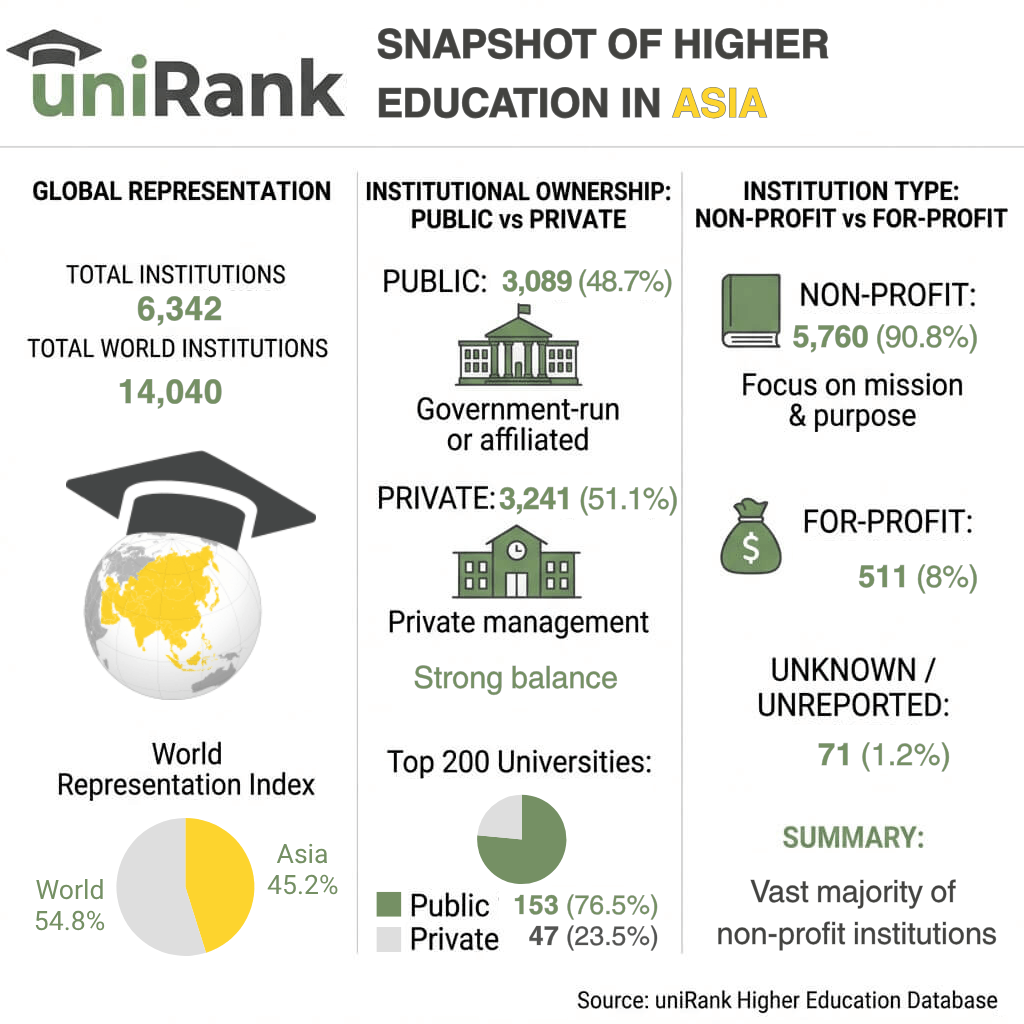
How many Universities are there in Asia in 2025? According to the uniRank database, which selects only institutions offering at least four-year undergraduate degrees (bachelor's degrees) or postgraduate degrees (master's or doctoral degrees), there are currently 6,350 officially recognized higher-education institutions in Asia. Considering that the uniRank database includes a total number of 14,103 officially recognized higher education institutions the proportion of Asian Universities in the world is as follows:

  • uniRank Asian Universities World Representation Index: 45.3%

Being the estimated population of the Asian continent around 59.8% of the total world population (source: United Nations' World Population Prospects, the 2015 Revision), the Asian Higher education system and offerings seem to be strongly underrepresented in the world at least in terms of the number of higher education institutions.


Public vs Private Universities in Asia

How many public and private Universities are there in Asia in 2025? Out of the total number of 6,350 recognized higher education institutions in Asia included in the uniRank database, 3,091 (48.7%) are public (i.e. officially affiliated to or run by national, state or local governments) and 3,246 (51.1%) are private.

In terms of the number of public versus private Universities, the uniRank database shows a slightly higher presence of private higher education institutions in the Asian continent as a whole. However, 153 (76.5%) out of the top 200 Universities in Asia are public higher education institutions. Differences and peculiarities may still exist in each Asian country's higher education system.


Non-profit vs for-profit Universities in Asia

What type of entities are Universities in Asia in 2025? Out of the total number of 6,350 recognized higher education institutions in Asia included in the uniRank database, 5,766 (90.8%) are non-profit and 512 (8%) are for-profit. The type of entity of the remaining Asian Universities included in the uniRank database is unknown or it has not been reported (1.1%). As a general rule, the vast majority of Asian public higher education institutions are not-for-profit organizations, not necessarily in legal terms but certainly in terms of nature and institutional purposes such as role, scope and mission.


Challenges for the higher education systems in Asia

In the era of the Indo-Pacific, Asia is home to some of the world’s fastest-growing and most diverse higher education systems. Over the past decades, many Asian countries have expanded university access, invested in research capacity and positioned themselves as global education hubs. Yet despite this growth, higher education across the continent continues to face complex and uneven challenges.

According to uniRank, higher education institutions throughout Asia encounter a series of systemic issues that affect educational quality, equity, employability and international competitiveness. This report highlights the key challenges shaping the Asian higher education landscape.


A) Access and Affordability

Although enrolment has increased dramatically, access remains uneven—especially between urban and rural regions. Millions of students from low-income families continue to face obstacles such as:

  • high tuition fees and limited financial aid
  • unequal distribution of universities across large geographic areas
  • limited access to preparatory education and digital learning tools
  • high cost of living in major education hubs

As Asia’s population expands, ensuring equitable access to higher education remains a core challenge.

B) Quality and Academic Standards

While several Asian universities now rank among the world’s top institutions, the overall quality of higher education across the region is highly uneven. Challenges include:

  • a shortage of trained and experienced faculty
  • overcrowded classrooms due to rapidly rising enrolments
  • outdated curricula that do not align with global standards
  • limited investment in faculty development and research facilities

This imbalance results in significant differences in academic outcomes between countries—and even within the same country.

C) Insufficient Funding

Many Asian governments invest heavily in higher education, but the demand for expansion often outpaces available resources. Public institutions in lower-income countries, in particular, face:

  • tight budgets and infrastructure shortages
  • limited research grants
  • an overreliance on student tuition fees
  • a lack of sustainable investment models

These constraints make it difficult for universities to meet the growing needs of students, employers and society.

D) Research and Innovation Gaps

Asia includes some of the world’s leading research nations—such as China, Japan, South Korea and Singapore. But research capacity across the continent remains uneven. Many universities face obstacles such as:

  • insufficient laboratory infrastructure
  • a shortage of research-trained faculty
  • limited international research collaboration
  • difficulty translating basic research into commercial innovations

This contributes to wide disparities in research output and innovation performance across the region.

E) Digital Transformation and Technology Readiness

Technology is reshaping higher education worldwide, yet the pace of digital adoption varies significantly in Asia. Common challenges include:

  • unreliable internet connectivity in rural regions
  • limited access to digital learning platforms
  • low digital literacy among students and faculty
  • insufficient integration of technology into teaching, research and administration

F) Graduate Employability and Skills Mismatch

A growing number of Asian graduates struggle to find jobs that match their qualifications. Many employers report that graduates lack critical skills such as:

  • problem-solving and analytical thinking
  • creativity and innovation
  • communication and teamwork
  • digital and technical capabilities

This skills gap limits productivity and slows economic development, particularly in rapidly industrializing economies.

G) Internationalization Challenges

As global mobility increases, Asian universities seek to attract more international students and build international partnerships. However, several obstacles persist:

  • language barriers in non-English-speaking countries
  • inconsistent visa processes
  • limited marketing and global visibility
  • difficulties retaining international faculty due to policy restrictions or administrative burdens

While Asia is emerging as a global education hub, many institutions still lag behind in creating an internationally friendly academic environment.

H) Lack of Harmonization Across the Continent

Asia is extremely diverse and higher education systems vary widely in structure, accreditation and quality assurance. Unlike Europe’s Bologna Process, Asia does not have a continent-wide harmonization framework. Existing initiatives such as ASEAN University Network (AUN), Campus Asia and UNESCO regional programs help, but harmonization efforts remain fragmented and limited to subregions.

This fragmentation makes cross-border recognition of degrees, student mobility and regional integration more difficult.

Conclusion

Addressing these challenges will require coordinated action from governments, regional organizations, universities, industry partners and international agencies. Priorities include increasing funding, ensuring equitable access, modernizing curricula, enhancing research capacity, building digital infrastructure and fostering greater harmonization across Asia’s diverse education systems.

With strategic investment and sustained collaboration, Asia, in the era of the Indo-Pacific, is positioned to strengthen its role as a global education leader and to better prepare its rapidly growing student population for the challenges of the 21st century.


Top 200 Universities in Asia

uniRank publishes twice a year a non-academic university ranking of the top 200 Universities in Asia based on valid, unbiased and non-influenceable web metrics provided by independent web intelligence sources. Please read the ranking methodology on the About Us page for more information.


Feedback / Error Report