Universities and Higher Education in Africa

Universities in Africa

Higher Education in Africa

Introduction

What are the most popular Universities in each African country? uniRank answers this question by publishing a comprehensive list of African countries, each accompanied by a ranking of its higher education institutions that meet the following uniRank selection criteria:

  • Accreditation: the institution must be chartered, licensed or accredited by the appropriate higher education-related organization in its country.
  • Degree Offerings: it must offer at least three-year bachelor’s degrees, or postgraduate master’s or doctoral degrees.
  • Mode of Delivery: it must deliver courses predominantly in a traditional, non-distance education format.

In addition to the rankings, uniRank also provides a Google-powered search engine that allows users to search all universities in Africa and a snapshot of higher education in Africa.

African Universities by Country

African Universities Search Engine

search 1,274 universities in Africa

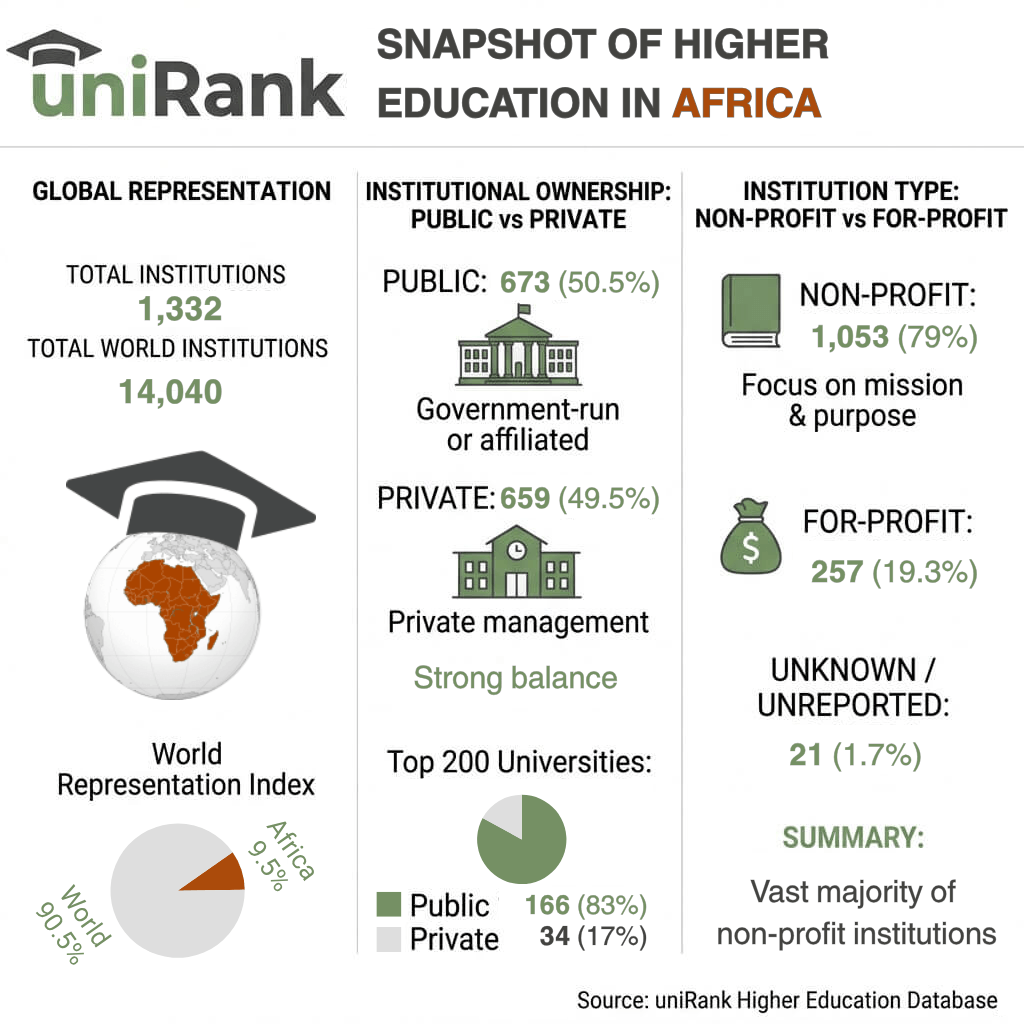
Snapshot of Higher Education in Africa

Higher Education and Universities in Africa

African Universities World Representation

How many Universities are there in Africa in 2025? According to the uniRank database in 2025 there are currently 1,331 officially recognized higher-education institutions in Africa. Considering that the uniRank database includes a total number of 14,103 officially recognized higher education institutions the proportion of African Universities in the world is as follows:

  • uniRank African Universities World Representation Index: 9.4%

Being the estimated population of the African continent around 16,1% of the total world population (source: United Nations' World Population Prospects, the 2015 Revision), the African Higher education system and offerings seem to be strongly underrepresented in the world at least in terms of the number of higher education institutions.


Public vs Private Universities in Africa

How many public and private Universities are there in Africa in 2025? Out of the total number of 1,331 recognized higher education institutions in Africa included in the uniRank database, 675 (50.7%) are public (i.e. officially affiliated to or run by national, state or local governments) and 656 (49.3%) are private.

In terms of the number of public versus private Universities, the uniRank database shows a strong balance between public versus private universities and higher education in the African continent as a whole. However, it is worth noting that 166 (83%) out of the top 200 Universities in Africa published by uniRank are public higher education institutions. Differences and peculiarities may still exist in each African country's higher education system.


Non-profit vs for-profit Universities in Africa

What type of entities are Universities in Africa in 2025? Out of the total number of 1,331 recognized higher education institutions in Africa included in the uniRank database, 1,053 (79.1%) are non-profit and 256 (19.2%) are for-profit. The type of entity of the remaining African Universities included in the uniRank database is unknown or it has not been reported (1.65%). The vast majority of African public universities are not-for-profit organizations, not necessarily in legal terms but certainly in terms of nature and institutional purposes such as role, scope and mission.


Challenges for the higher education systems in Africa

Africa’s higher education sector has expanded rapidly over the last two decades, driven by rising demand, demographic growth and an increased recognition of the role that universities play in economic development. However, despite this progress, institutions across the continent continue to face structural and systemic challenges that affect the quality, accessibility and global competitiveness of education.

According to uniRank, the higher education systems in Africa encounter a wide range of obstacles that impact both institutions and their students. Below is a report outlining the continent’s key challenges and the implications for the future.


A) Limited Access and Affordability

Access to higher education in Africa remains significantly lower than the global average. Barriers include poverty, insufficient secondary school completion, long travel distances to campuses, inadequate transportation networks and a shortage of universities—especially in rural areas.

Even when students are admitted, the rising cost of tuition, accommodation, books, food and technology makes attending university financially challenging. As a result, higher education remains unreachable for many qualified young Africans.

B) Quality and Standards of Education

The quality of education varies widely across institutions. While some African universities meet international standards, many struggle due to:

  • outdated curricula
  • insufficiently qualified or underpaid faculty
  • large student-to-lecturer ratios
  • limited research culture
  • aging or overcrowded infrastructure

These factors contribute to uneven academic performance, weakening the reputation of higher education institutions and affecting graduate outcomes.

C) Chronic Underfunding

Most African governments allocate limited budgets to higher education. Competing national priorities—such as healthcare, basic education, security and infrastructure—often reduce university funding.

Underfunding leads to deteriorating facilities, insufficient staff recruitment, low salaries, limited research grants and restricted expansion of academic programs.

D) Weak Research and Innovation Output

While African researchers contribute important work—particularly in health, agriculture and environmental science—many universities lack the tools needed to support large-scale research.

  • Laboratories and equipment are often outdated or insufficient.
  • Funding for R&D remains low compared to global averages.
  • Collaboration between universities, government and industry is limited.

These shortcomings result in low publication rates, reduced innovation and limited participation in global scientific networks.

E) Technology Gaps and Digital Readiness

Digital transformation is reshaping global higher education, yet African institutions face persistent challenges such as:

  • unstable or expensive internet connectivity
  • inadequate computer laboratories
  • limited access to learning management systems (LMS)
  • insufficient digital literacy among students and faculty

The COVID-19 pandemic highlighted these gaps as many institutions struggled to transition to remote learning.

F) Employability and Curriculum Relevance

A growing mismatch exists between the skills universities teach and the skills employers need. As a result, many graduates face unemployment or underemployment despite holding degrees.

Reasons include:

  • curricula not updated to reflect labour market trends
  • limited industry placements or internships
  • weak partnerships between universities and employers
  • overemphasis on theoretical learning over practical training

This “skills gap” affects economic competitiveness and restricts youth employment growth across the continent.

G) Limited Internationalization

In an increasingly interconnected world, African universities face challenges in attracting international students, forging global partnerships and recruiting foreign faculty.

  • language barriers in non-Anglophone regions
  • visa restrictions and bureaucratic hurdles
  • reputational concerns or safety issues in some countries
  • limited global visibility of African institutions

As a result, Africa remains underrepresented in global academic mobility networks.

H) Lack of Harmonization Across the Continent

African higher education systems differ significantly in degree structures, academic calendars, quality assurance procedures and accreditation standards.

This fragmentation makes:

  • student mobility difficult
  • degree recognition inconsistent
  • cross-border university cooperation complex

While regional frameworks such as the African Continental Qualifications Framework (ACQF) exist, implementation remains slow and uneven.

I) Political and Economic Instability

Instability threatens campuses, disrupts funding and deters international collaboration. Conflicts, civil unrest, corruption and sudden policy changes can interrupt university operations, discourage investment and force academic talent to migrate elsewhere.

Conclusion

Addressing these challenges will require strong collaboration among governments, regional and international organizations, private-sector partners and the universities themselves. Key priorities include increasing investment, improving infrastructure, embracing digital transformation, harmonizing systems, strengthening research partnerships and aligning training with labour market needs.

With consistent commitment and coordinated action, Africa’s higher education systems have the potential to become more accessible, innovative and globally competitive—supporting the continent’s long-term development and its rapidly growing youth population.


Top 200 Universities in Africa

uniRank publishes twice a year a university ranking of the top 200 Universities in Africa based on valid, unbiased and non-influenceable web metrics provided by independent web intelligence sources. Please read the ranking methodology on the About Us page for more information.


Feedback / Error Report