Universities and Higher Education in Oceania

Universities in Oceania

Higher Education in Oceania

Introduction

What are the most popular Universities in each Oceanian country? UniRank endeavors to address this query by publishing a list of Oceanian countries and providing a ranking of their higher-education institutions meeting the following uniRank selection criteria:

  • Accreditation: the institution must be chartered, licensed or accredited by the appropriate higher education-related organization in its country.
  • Degree Offerings: it must offer at least three-year bachelor’s degrees, or postgraduate master’s or doctoral degrees.
  • Mode of Delivery: it must deliver courses predominantly in a traditional, non-distance education format.

UniRank also publishes below a search engine powered by Google that searches all Universities in Oceania and a statistical snapshot of higher education in Oceania and its current challenges.

Oceania Universities by Country

Oceania Universities Search Engine

search 62 universities in Oceania

Snapshot of Higher Education in Oceania

Higher Education and Universities in Oceania

Oceanian Universities World Representation

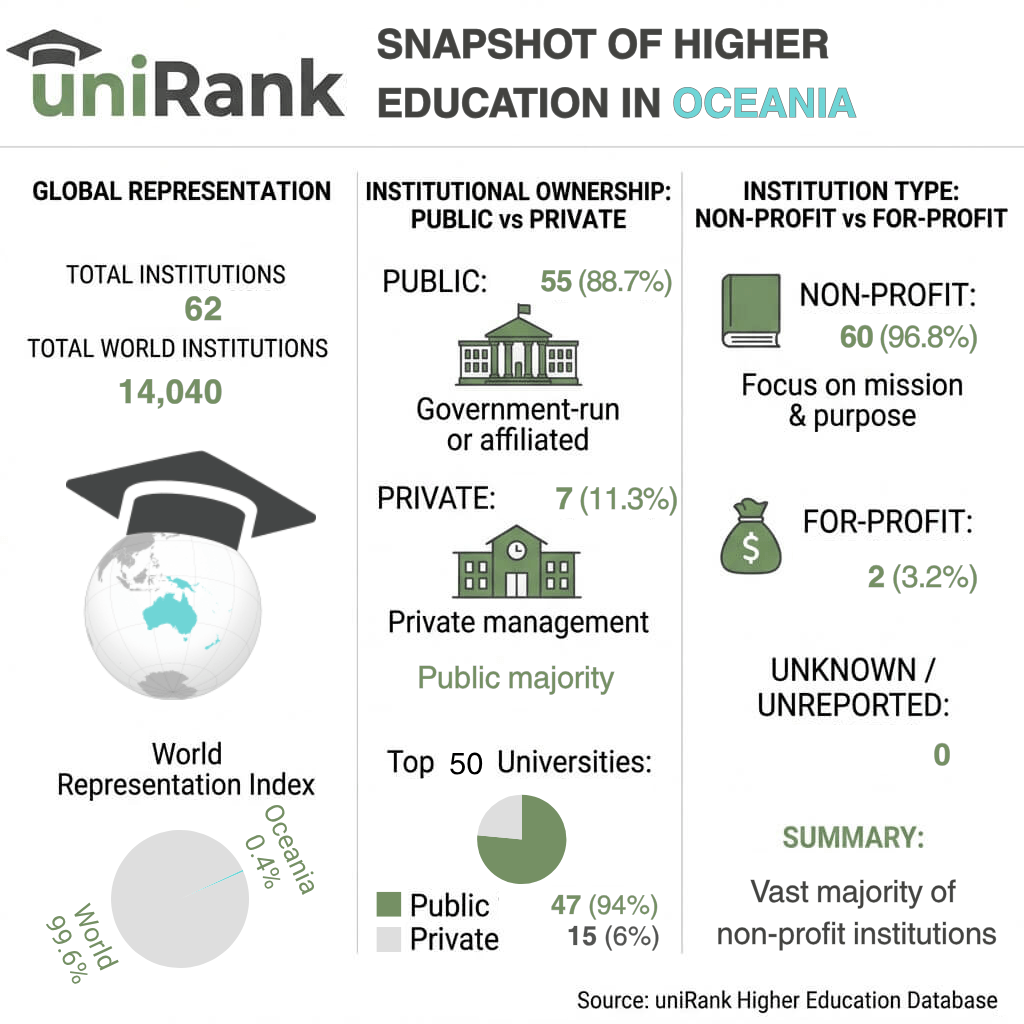
How many Universities are there in Oceania in 2025? According to the uniRank database there are currently 63 officially recognized higher-education institutions in Oceania. Considering that the uniRank database includes a total number of 14,103 officially recognized higher education institutions the proportion of Oceanian Universities in the world is as follows:

  • uniRank Oceanian Universities World Representation Index: 0.45%

Being the estimated population of the Oceanian continent around 0.53% of the total world population (source: United Nations' World Population Prospects, the 2015 Revision), the Oceanian Higher education system and offerings seem to be fairly represented in the world at least in terms of the number of higher education institutions.


Public vs Private Universities in Oceania

How many public and private Universities are there in Oceania in 2025? Out of the total number of 63 recognized higher education institutions in Oceania included in the uniRank database, 56 (89%) are public (i.e. officially affiliated to or run by national, state or local governments) and 7 (11%) are private.

In terms of the number of public versus private Universities, the uniRank database shows a much higher presence of public higher education institutions in the Oceanian continent as a whole. Moreover, 47 (94%) out of the top 50 Universities in Oceania are public higher education institutions. Differences and peculiarities may still exist in each Oceanian country's higher education system.


Non-profit vs for-profit Universities in Oceania

What type of entities are Universities in Oceania in 2025? Out of the total number of 63 recognized higher education institutions in Oceania included in the uniRank database, 61 (96.8%) are non-profit and 2 (3.2%) is for-profit. As a general rule, the vast majority of Oceanian public higher education institutions are not-for-profit organizations, not necessarily in legal terms but certainly in terms of nature and institutional purposes such as role, scope and mission.


Challenges for the higher education systems in Oceania

Higher education in Oceania, which includes countries such as Australia, New Zealand and the Pacific Island nations, is an important driver of economic growth, innovation and social development. Despite its strengths, the sector faces a variety of challenges. According to uniRank, the main issues include access and affordability, funding, technology adoption and Indigenous education.


A) Access and Affordability

Access to higher education in Oceania is uneven, particularly for students from disadvantaged backgrounds, rural areas, or remote islands. Financial barriers, limited local infrastructure and the high cost of relocation or living expenses make it difficult for many students to pursue tertiary education.

Students from low-income families and marginalized communities are often most affected and addressing these disparities is crucial to ensure equitable access to higher education across the region.

B) Funding

Funding is a critical concern for higher education institutions in Oceania. Many universities and colleges face financial pressures that affect their ability to maintain operations, offer competitive salaries and attract or retain high-quality faculty.

In Australia and New Zealand, government funding and tuition fees are major sources of income, but institutions still struggle to balance quality education with financial sustainability. Smaller Pacific Island universities often face even greater challenges due to limited domestic resources and reliance on external aid.

C) Technology and Digital Transformation

Technology is increasingly central to teaching, learning and administration in higher education. Online learning, digital resources and research tools offer new opportunities for students and staff.

  • Infrastructure gaps: not all institutions have the resources to implement or maintain up-to-date technology
  • Training needs: faculty and staff require ongoing support to use technology effectively in teaching and administration
  • Equity concerns: students in remote or rural areas may have limited access to reliable internet or devices

Effective integration of technology is essential to expand access, improve learning outcomes and remain globally competitive.

D) Indigenous Education

Indigenous students in Oceania face unique challenges in higher education. These include cultural and linguistic barriers, limited representation in curricula and a lack of recognition of Indigenous knowledge systems by non-Indigenous faculty.

Supporting Indigenous students requires culturally responsive teaching, tailored academic and social support and inclusive policies that respect and incorporate Indigenous perspectives into higher education.

Moving Forward: Potential Solutions

Addressing these challenges will require coordinated action from governments, universities and other stakeholders across Oceania. Potential strategies include:

  • Increasing public funding and ensuring sustainable financial support for institutions
  • Investing in digital infrastructure and technology to support online learning and research
  • Expanding scholarship programs and support services for students from disadvantaged backgrounds and remote areas
  • Enhancing Indigenous education through culturally inclusive curricula, mentorship and academic support programs
  • Strengthening partnerships between universities, local communities and international organizations

Conclusion

By implementing these strategies, higher education systems in Oceania can become more accessible, inclusive and responsive to the needs of students, communities and the broader region.


Top 50 Universities in Oceania

uniRank publishes twice a year a non-academic university ranking of the top 50 Universities in Oceania based on valid, unbiased and non-influenceable web metrics provided by independent web intelligence sources. Please read the ranking methodology on the About Us page for more information.


Feedback / Error Report