Universities and Higher Education in North America

Universities in North America

Higher Education in North America

Introduction

What are the most popular Universities in each North American country? uniRank answers this question by publishing a list of North American countries and providing a ranking of their higher-education institutions meeting the following uniRank selection criteria:

  • Accreditation: the institution must be chartered, licensed or accredited by the appropriate higher education-related organization in its country.
  • Degree Offerings: it must offer at least three-year bachelor’s degrees, or postgraduate master’s or doctoral degrees.
  • Mode of Delivery: it must deliver courses predominantly in a traditional, non-distance education format.

UniRank also publishes below a search engine powered by Google that searches all Universities in North America and a statistical snapshot of higher education in North America and its current challenges.

North American Universities by Country

North American Universities Search Engine

search 1,840 universities in North America

Snapshot of Higher Education in North America

Higher Education and Universities in North America

North American Universities World Representation

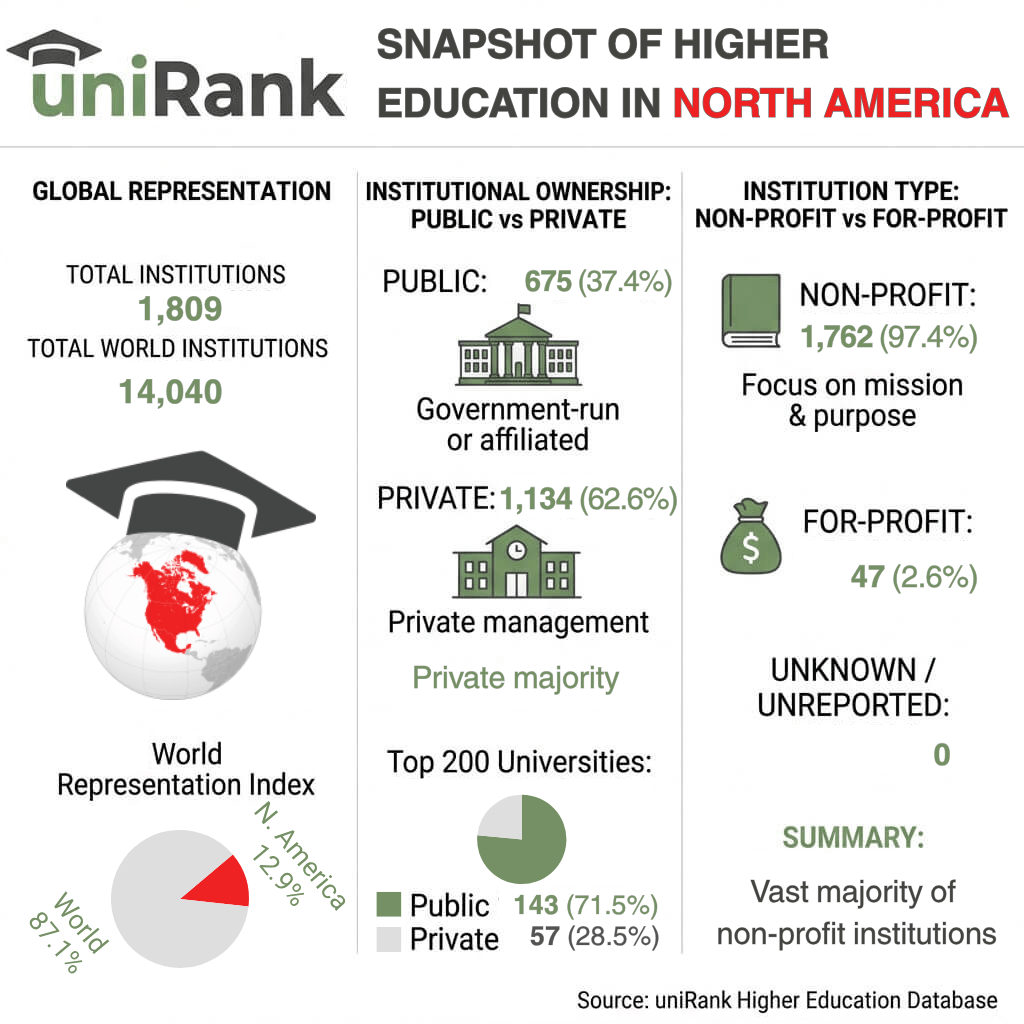
How many colleges and universities are there in North America in 2025? According to the uniRank database, which selects only institutions offering at least four-year undergraduate degrees (bachelor's degrees) or postgraduate degrees (master's or doctoral degrees), there are currently 1,829 officially recognized higher-education institutions in North America. Considering that the uniRank database includes a total number of 14,103 officially recognized higher education institutions the proportion of North American Universities in the world is as follows:

  • uniRank North American Universities World Representation Index: 13%

Being the estimated population of the North American continent around 4,9% of the total world population (source: United Nations' World Population Prospects, the 2015 Revision), the North American Higher education system and offerings seem to be significantly overrepresented in the world at least in terms of the number of higher education institutions.


Public vs Private Universities in North America

How many public and private colleges and universities are there in North America in 2025? Out of the total number of 1,829 recognized higher education institutions in North America included in the uniRank database, 678 (37.1%) are public (i.e. officially affiliated to or run by national/federal, state or local governments) and 1,151 (62.9%) are private.

In terms of the number of public versus private Universities, the uniRank database shows a much higher presence of private higher education institutions in the North American area as a whole. However, 143 (71.5%) out of the top 200 Universities in North America are public higher education institutions. Differences and peculiarities may still exist in each North American country's higher education system.


Non-profit vs for-profit Universities in North America

What type of entities are Universities in North America in 2025? Out of the total number of 1,829 recognized higher education institutions in North America included in the uniRank database, 1,780 (97.3%) are non-profit and 48 (2.6%) are for-profit. As a general rule, the vast majority of North American public higher education institutions are not-for-profit organizations, not necessarily in legal terms but certainly in terms of nature and institutional purposes such as role, scope and mission.


Challenges for the higher education systems in North America

Higher education in North America—primarily the United States and Canada—remains among the world’s most respected and innovative. Yet, despite its strengths, the sector faces several persistent and emerging challenges. According to uniRank, the most critical issues include access and affordability, rising student debt, workforce relevance and the rapid evolution of technology.


A) Access and Affordability

Access to higher education continues to be uneven, particularly for underrepresented and low-income students. Financial obstacles, disparities in K–12 academic preparation and systemic barriers still limit opportunities for many learners.

Tuition fees, housing costs, textbooks and cost of living have increased steadily in both the United States and Canada. Even with financial aid and scholarship programs, many students and families struggle to afford postsecondary education.

B) Rising Student Debt

Student debt has become a defining issue in the United States, where many graduates leave college with substantial loan burdens. This debt can affect major life decisions, such as career paths, home ownership and financial planning.

Although Canada’s public funding model differs, Canadian students also increasingly rely on loans and face growing financial pressures related to tuition and living costs. Debt after graduation remains a significant concern across both countries.

C) Employability and Workforce Relevance

Employers and policymakers frequently highlight a growing skills gap between what students learn in higher education and what the labor market demands. Graduates sometimes report difficulty transitioning into careers that match their academic training.

This includes both:

  • Technical skills — digital literacy, STEM capabilities, data analysis and industry-specific competencies;
  • Soft skills — communication, teamwork, critical thinking and problem-solving.

To remain relevant, higher education institutions must deepen their collaboration with industry and expand opportunities for experiential learning, internships and work-integrated programs.

D) Technology and Digital Transformation

Digital transformation continues to reshape higher education. Online and hybrid learning models offer flexibility, but also require significant investment and thoughtful design.

  • Infrastructure needs: universities must continuously update digital systems and ensure cybersecurity
  • Quality of instruction: online learning must maintain academic rigor and student engagement
  • Equity challenges: not all students have equal access to devices, reliable internet, or quiet study spaces
  • Faculty training: educators need ongoing support to effectively integrate new technologies into teaching

While technology expands learning opportunities, it should complement—not replace—the value of in-person instruction and human interaction.

Moving Forward: Potential Solutions

Addressing these challenges will require cooperation among policymakers, educational institutions, employers and communities across the United States and Canada. Potential approaches include:

  • Increasing public investment in financial aid and scholarships
  • Strengthening K–12 education systems to improve college preparedness
  • Providing more academic, mental health and career support services
  • Aligning academic programs more closely with labor market needs
  • Supporting alternative pathways such as microcredentials and work-based learning

Conclusion

As demographic, economic and technological changes continue to evolve, higher education systems in the United States and Canada must adapt to ensure they remain accessible, relevant and high-quality for all students.


Top 200 Universities in North America

uniRank publishes twice a year a non-academic university ranking of the top 200 Universities in North America based on valid, unbiased and non-influenceable web metrics provided by independent web intelligence sources. Please read the ranking methodology on the About Us page for more information.


Feedback / Error Report